Why Is MCA Now 2 Years Instead of 3? UGC Guidelines Explained
The MCA (Master of Computer Applications) program in India is now primarily offered as a 2-year postgraduate degree under the revised UGC MCA 2020 Guidelines and the National Education Policy (NEP). This change was introduced to eliminate repetitive coursework, align Indian education with global standards, and help students complete their postgraduate studies more efficiently. Most universities now follow the 2-year MCA structure, which focuses on advanced computing skills, industry readiness, and practical learning.
The revised MCA curriculum includes modern subjects such as Artificial Intelligence, Cloud Computing, Cyber Security, Machine Learning, and Software Engineering, along with projects and internship opportunities. Despite the reduced duration, the 2-year MCA holds the same academic value as the earlier 3-year program when offered by a recognized university. It enables students to enter the job market faster while gaining the technical knowledge and practical skills required for today's technology-driven careers.
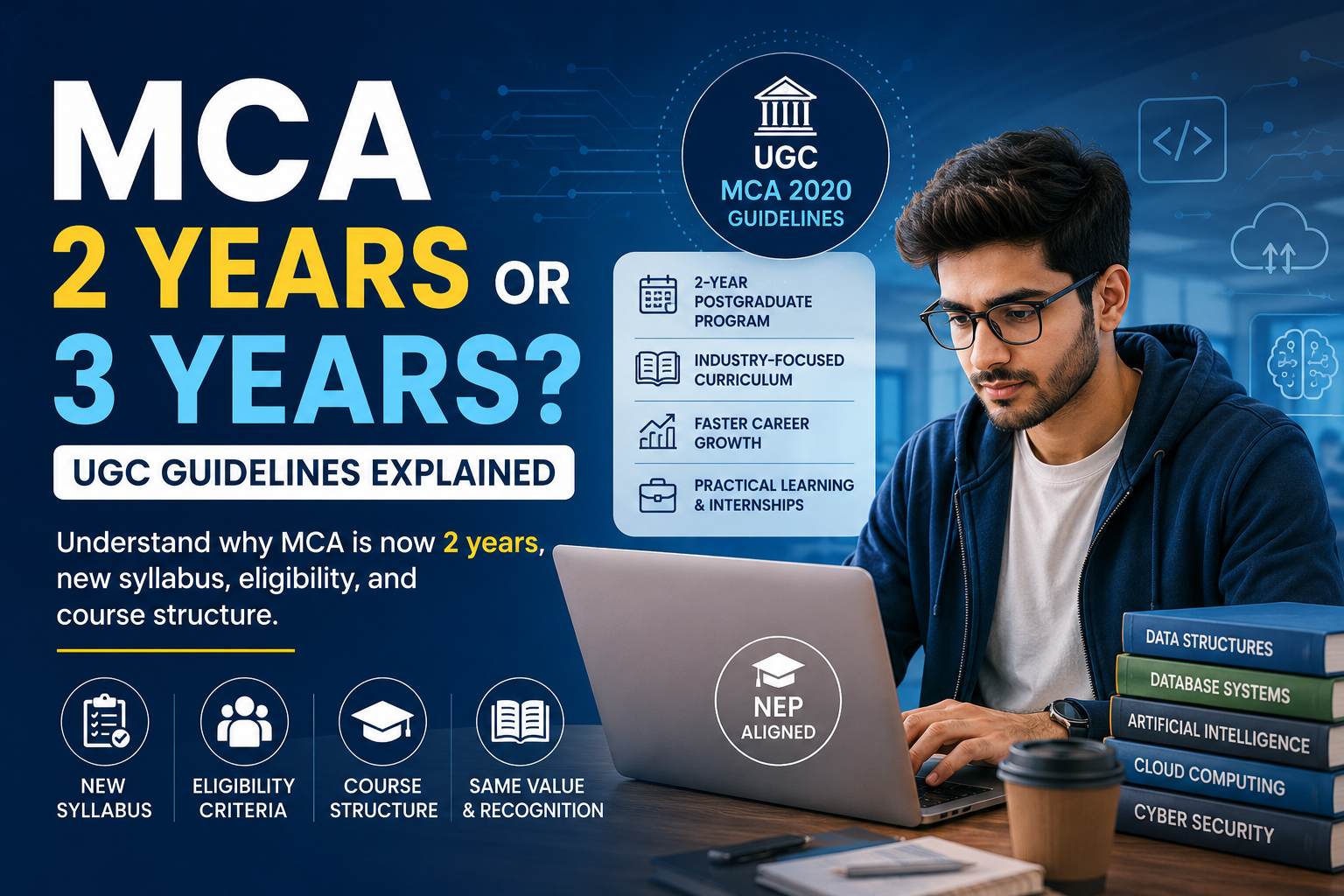
MCA 2 Years or 3 Years? UGC Guidelines Explained
If you're wondering whether MCA is 2 years or 3 years, the answer is simple: the standard MCA program in India is now a 2-year postgraduate degree for eligible graduates, following reforms introduced under the UGC MCA 2020 Guidelines and the National Education Policy (NEP) framework.
Earlier, MCA was commonly offered as a 3-year program. However, regulatory changes allowed universities to redesign the curriculum and reduce the duration to 2 years while maintaining academic credits and industry relevance. This change was made to align MCA with global postgraduate education standards and help students enter the workforce faster.
For students planning to pursue an MCA after graduation, understanding the latest MCA duration UGC guidelines is essential before applying.
What Is the Current MCA Duration in India?
As per the latest regulatory framework followed by UGC-DEB recognized universities and AICTE-approved MCA programs, the standard MCA duration in India is now 2 years for most students. Earlier, MCA was commonly offered as a 3-year postgraduate program. However, under the revised educational framework, universities have adopted a 2-year structure that focuses on advanced and industry-oriented learning while maintaining academic standards.
Students can still come across different MCA formats depending on the institution and program structure. The traditional MCA program followed a 3-year duration, whereas the revised MCA program is completed in 2 years. Additionally, some universities offer integrated BCA + MCA programs, which generally take 4 to 5 years to complete, depending on the university's curriculum and academic design.
Today, the majority of universities offering MCA admissions follow the 2-year structure, making it the most widely accepted and preferred MCA format across India.
Who Is Eligible for the 2-Year MCA Program?
Eligibility for the 2-year MCA program varies slightly from one university to another. However, most institutions require candidates to hold a bachelor's degree from a recognized university and meet the minimum aggregate marks specified by the institution. Depending on the university's admission criteria, applicants may also need to have studied Mathematics either at the 10+2 level or during their graduation.
In addition to meeting the academic requirements, students may be required to complete university-specific admission processes, such as entrance examinations, interviews, or merit-based selection procedures. Candidates from educational backgrounds such as BCA, B.Sc. Computer Science, Information Technology, and other related disciplines are generally eligible to apply for MCA programs.
If you are planning your academic journey toward an MCA degree, pursuing a strong undergraduate program is an important first step. An Online BCA program, for example, can help you build a solid foundation in computer applications, programming, and information technology while preparing you for advanced studies and career opportunities in the technology sector.
Is a 3-Year MCA Still Available?
A few institutions may continue to offer program variations based on their academic framework, transition policies, or integrated pathways.
However, the majority of universities now follow the revised 2-year model because it aligns better with current regulatory and industry expectations.
Students should always verify the latest program structure directly from the university before applying.
How Does MCA Compare with an Online BCA Pathway?
Many students first complete an undergraduate computer applications degree and then pursue MCA for specialization and advanced technical skills.
A common academic progression is:
Online BCA → MCA → Software Development / Data Analytics / Cyber Security / Cloud Computing Careers
If you're still at the undergraduate stage, exploring an Online BCA program can help build the foundational programming and computer science knowledge required for MCA admission.
Why Was MCA Reduced from 3 Years to 2 Years?
The reduction in MCA duration was introduced to modernize computer application education and remove unnecessary academic overlap.
Key Reasons Behind the Change
-
Alignment with National Education Policy (NEP)
The education system has shifted towards flexible and outcome-based learning. The revised MCA structure supports faster postgraduate completion without compromising learning quality.
-
Industry-Relevant Curriculum
Technology evolves rapidly. A shorter yet intensive MCA program helps students learn current technologies and enter the job market sooner.
-
Removal of Repetitive Subjects
Many concepts previously taught in the first year of MCA were already covered in BCA, B.Sc. Computer Science, and related undergraduate programs.
-
Global Education Compatibility
Most international master's degrees in computing and information technology are completed within 1–2 years. The revised MCA structure aligns Indian education with global standards.
-
Faster Career Progression
Students can complete their postgraduate studies earlier and start working, preparing for competitive exams, or pursuing research opportunities.
What Do the UGC MCA 2020 Guidelines Say?
The major shift came after the introduction of the UGC MCA 2020 Guidelines and related higher education reforms that encouraged universities to adopt a more streamlined postgraduate structure.
Under the revised framework:
- MCA is recognized as a postgraduate degree.
- Universities can structure MCA as a 2-year program with the required academic credits.
- Curriculum should focus on advanced computing skills and industry-ready competencies.
- Institutions are encouraged to incorporate emerging technologies and practical learning.
The objective was not simply to reduce the duration but to improve the quality and relevance of the degree.
What Is Included in the New MCA Syllabus?
The new MCA syllabus has been redesigned to meet current industry requirements.
Core Subjects
- Data Structures and Algorithms
- Database Management Systems
- Operating Systems
- Computer Networks
- Software Engineering
- Object-Oriented Programming
- Web Technologies
- Cloud Computing
- Cyber Security
- Artificial Intelligence
- Machine Learning Fundamentals
Practical Components
- Programming Laboratories
- Mini Projects
- Industry Case Studies
- Capstone Projects
- Internship Opportunities
Many universities also offer elective specializations to help students build expertise in specific domains.
Does the 2-Year MCA Have the Same Value as the Old 3-Year MCA?
Yes. The revised 2-year MCA offered by recognized universities carries the same academic recognition as earlier MCA programs, provided the institution follows applicable UGC and AICTE regulations.
Employers generally focus on:
- University recognition
- Technical skills
- Internship experience
- Project portfolio
- Practical knowledge
The duration alone does not reduce the degree's value. Most recruiters evaluate candidates based on their skills, practical exposure, and ability to apply knowledge in real-world situations rather than the length of the program itself.
Should You Choose a 2-Year MCA?
For most students, the answer is yes.
A 2-year MCA offers:
- Faster completion of postgraduate education.
- Reduced overall education cost.
- Earlier entry into the job market.
- Updated industry-focused curriculum.
- Better alignment with modern technology careers.
The shorter duration does not mean reduced learning. Instead, the curriculum is designed to be more focused, practical, and outcome-driven, ensuring that students develop the skills required for today's technology industry.
MCA 2 Years or 3 Years: Comparison Table
| Parameter |
Earlier 3-Year MCA |
Current 2-Year MCA |
| Duration |
3 Years |
2 Years |
| Semesters |
6 Semesters |
4 Semesters |
| Focus |
Foundation + Advanced Concepts |
Advanced & Industry-Oriented Learning |
| Industry Alignment |
Moderate |
High |
| Time to Employment |
Longer |
Faster |
| Curriculum Approach |
Traditional |
Outcome-Based |
| Technology Integration |
Limited |
Greater Focus on Emerging Technologies |
The current model emphasizes practical learning, project work, and specialization-oriented education.
What Is the Latest MCA Course Structure?
The revised MCA course structure generally follows a four-semester format.
Semester-Wise Overview
| Semester |
Focus Area |
| Semester 1 |
Core Computer Science Fundamentals |
| Semester 2 |
Advanced Programming and Databases |
| Semester 3 |
Emerging Technologies and Electives |
| Semester 4 |
Major Project, Internship, Research Work |
This structure ensures students gain both theoretical knowledge and practical industry exposure.
Frequently Asked Questions
Is MCA now officially 2 years?
Yes. Most universities in India now offer MCA as a 2-year postgraduate program under the revised higher education framework and updated curriculum structure.
Why was MCA changed from 3 years to 2 years?
The duration was reduced to remove repetitive coursework, align with global master's programs, and provide faster career opportunities for graduates.
What are the MCA duration UGC guidelines?
The revised UGC framework allows universities to offer MCA as a 2-year postgraduate degree while maintaining the required academic standards and learning outcomes.
Does the new MCA syllabus differ from the old syllabus?
Yes. The new MCA syllabus places greater emphasis on industry-focused technologies such as AI, cloud computing, cyber security, software development, and practical project work.
Is a 2-year MCA valid for government jobs and higher studies?
Yes. A 2-year MCA from a recognized university is generally accepted for employment, competitive examinations, and further education opportunities, subject to specific eligibility requirements.